
Please note: This blog and its accompanying video discuss the important and troubling issue of weight bias and discrimination, which may be a sensitive topic for some readers.
How might weight stigma be a vicious cycle?
Although total fasting can dramatically increase blood levels of the stress hormone cortisol, as much as doubling within five days, dieting alone does not. There is, however, a way stress and obesity could turn into a vicious cycle: weight stigma.
Across thousands of individuals followed for four years, those reporting discriminatory experiences had more than twice the odds of becoming obese. Those who started out obese had more than three times the odds of staying that way compared to those who started at the same weight but did not experience discrimination. Now, this could be from stress-induced eating on one side of the calorie-balance equation or stigma-induced exercise avoidance on the other.
Obese individuals with more frequent experiences with weight stigma report greater avoidance of exercising in public, feeling judged and embarrassed. These “too fat to exercise” fears may be well-grounded. Strong anti-fat biases have been documented in both fitness professionals and regular gym-goers, “which may translate into an unwelcoming environment at fitness centers and health clubs.”
Whichever side of the calorie equation that gets tipped, those who experience weight stigma can also end up suffering health consequences independent of any added weight. Those reporting more frequent weight-based discrimination exhibit higher levels of depression, show higher levels of inflammation, experience higher levels of oxidative stress, and have a shorter lifespan. Two studies following nearly 20,000 people both found about a 50% increase in mortality risk among those reporting greater daily discrimination. “[W]eight discrimination may shorten life expectancy.” Despite these hazards, some scholars advocate for even more fat-shaming.
The President Emeritus of the prestigious Hastings Center infamously advocated for “a kind of stigmatization lite,” using social pressures to compel people to lose weight without resorting to “outright discrimination.” After all, he argued, what else has the potential to counter the persuasive force of the billions spent in advertising every year by the food and beverage industries? It worked against tobacco. He recalls his own battle with addiction: “The force of being shamed and beat upon socially was as persuasive for me to stop smoking as the threats to my health.” The public health campaign to stigmatize cigarette smoking turned “what had been considered simply a bad habit into reprehensible behavior.”
When such campaigns have been tried, they have been met with fierce resistance, though. Georgia’s Strong4Life campaign featured billboards of morose-looking obese children with captions like “Warning: Chubby kids may not outlive their parents” or “It’s hard to be a little girl if you’re not,” which you can see below and at 3:16 in my video The Impacts of Weight Bias in Health Care.
The campaign sponsors defended the ads as an attempt to break through the denial in a state with some of the highest recorded childhood obesity rates. It’s only defensible, though, if it works.
Yale researchers found that when normal-weight women are provided with bowls of M&M’s, jelly beans, and chips to snack on after watching clips of stigmatizing material like clumsy, loud, lazy stereotypes getting teased about their weight, they eat about the same amount compared to watching neutral material, such as insurance commercials. But when overweight women watch the same two sets of videos, they triple their calorie intake after watching the stigmatizing scenes, as you can see below and at 3:56 in my video.
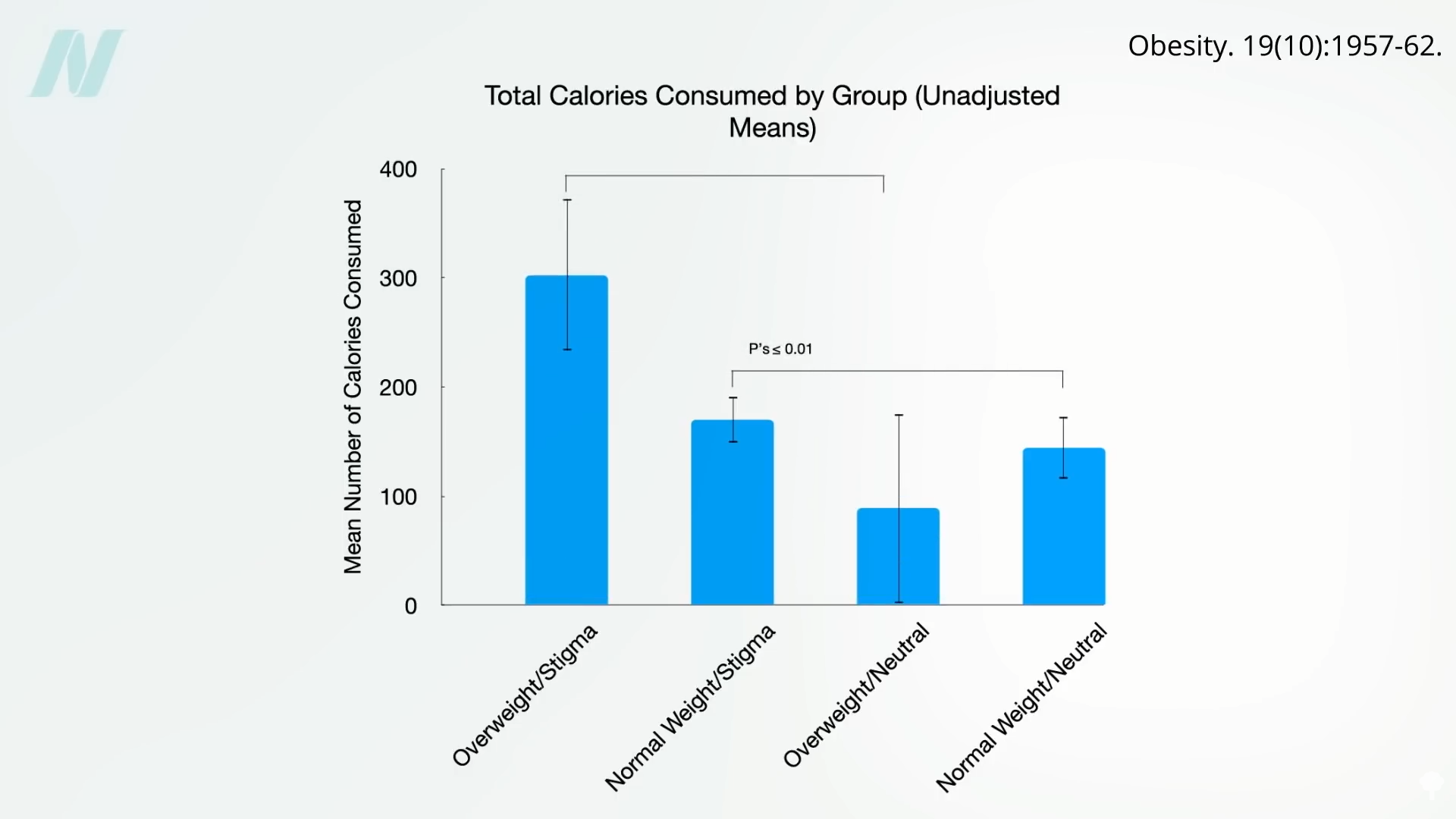
The researchers concluded, “This directly challenges the notion that pressure to lose weight in the form of weight stigma will have a positive, motivating effect on overweight individuals.” In other words, it could make matters worse. Being labeled “too fat” during childhood was associated with a higher risk of becoming obese, compared to children of the same weight who were never told that. But does that mean we should just ignore concerns about obesity? Many doctors apparently think so.
Just as veterinarians have been found to be reluctant to tell people their pets are obese, fewer than a quarter of parents of overweight children report having been told by pediatricians about their child’s weight status. One might think it would be obvious, but a Gallup Survey found that parents appear to be “notoriously poor judges of their children’s weight.” Similarly, the percentage of adults who describe themselves as overweight has remained essentially unchanged over the past few decades, despite skyrocketing obesity. “All of this helps ‘paint a picture of mass delusion in the United States about its rising weight,’” Gallup concluded.
I think patients have the right to be informed. Those told by their doctor that they are overweight have about four times the odds of attempting weight loss and about twice the odds of succeeding.
Just as smoking physicians are less likely to challenge their smoking patients, overweight physicians are less likely to bring up the subject of weight loss or even document obesity in their charts.
Ironically, overweight patients trust diet advice from overweight doctors more than from doctors of normal weight. Unfortunately, primary care physicians appear to have little to offer in terms of specifics. Fewer than half who were surveyed said they provide specific advice to their patients. Just telling patients to “watch what they eat” is unlikely to be particularly helpful, but many primary care physicians may not even go that far. Most physicians said they would spend more time working with patients on weight management if only their time was “reimbursed appropriately.” Maybe we could offer a bonus to refrain from blaming the victim. As one pair of commentators wrote in response to the pro-stigma camp, “If shaming reduced obesity, there would be no fat people.”
I want to end this weight stigma series with the jaw-dropping findings of a study that I think best illustrates how hard it is to live inside an obese body. If this doesn’t foster sympathy among my medical colleagues, I don’t know what will. Researchers talked to men and women who had lost and kept off more than 100 pounds to tap into their unique insight, having personally experienced what it was like to be morbidly obese and then, on average, 126 pounds lighter. Forty-seven people were interviewed.
They were asked to think back to when they were heavier and make a choice: “If someone offered you a couple of million dollars if you stayed morbidly obese forever, would you have chosen the money? Or would you have chosen to be normal weight no matter what?”
Option 1 was “I would have chosen no money and being normal weight. It would have taken me one second to decide.” Option 2: “I probably would have chosen being normal weight. But the possibility of having that much money would make me think about the choice.” Option 3: “I wanted to be normal weight, but I could really use the money. If I could be a multimillionaire, I think I could live with being morbidly obese.”
One of the 47 had to think about it, but the other 46 jumped at option 1. No one chose option 3. They all said they would give up being a multimillionaire to be normal weight.
If that shocked you, buckle your seatbelts. They were then asked about being obese compared to other disabilities. Normally, when you ask people to choose between living with their own disability or switching to a different one, there is a strong proclivity to prefer their existing condition. For example, even though most people would rather be deaf than blind, blind people prefer to remain blind by a large margin, rather than having sight without sound. They already know how to live with their own disability, so there’s safety in familiarity. However, the exact opposite happened when the 47 formerly obese individuals were asked to choose.
Every single one of the 47 said they’d rather be deaf, dyslexic, diabetic, or have very bad acne or heart disease for the rest of their lives than be obese. More than 90% said they’d rather have a leg amputated, and similarly, about 9 out of 10 said they’d rather be legally blind than be obese. Obesity appears to be the only handicap where nearly everyone wants to switch, no matter what the cost. To quote one person in the study: ”When you’re blind, people want to help you. No one wants to help you when you’re fat.”
Doctor’s Note
If you missed the previous installment in this two-part series, see Weight Bias in Health Care. The information is drawn from my book How Not to Diet.